 The latest auto news, reviews, prices, product and vehicle releases.
 Jan
27th
Stay connected Subscribe to our RSS feed
From Pirelli
After a short winter break of just over two months, Formula 1 is back in action at Jerez in Spain this week, for the first of three four-day pre-season tests (with the following two tests scheduled for Bahrain, from 19-22 February and 27 February-2 March).
This will be the first appearance for many of the 2014 cars, as F1 undergoes a technical revolution with 1.6-litre turbocharged engines and multiple energy recovery systems powering the 2014 challengers, which will have to operate within a drastically reduced fuel allocation and revised aerodynamic rules.
These important changes present a completely different set of vehicle dynamics, so Pirelli has developed a brand new 2014 tire range to cater for these unique demands. All the 2014 slick tires have a new construction and new compounds, with slightly increased weight. The wet tire has a new tread pattern and a different compound.
Jerez, which has the roughest tarmac of any circuit visited by F1, will be the first opportunity for the teams to start integrating their new cars with the 2014 tires, while the final day will be devoted to wet weather tire testing on an artificially-watered track (unless it rains at any of the previous test days, in which case this will become the dedicated wet-weather test day).
Testing Facts:
* Teams are allowed an overall maximum total of 135 sets of tires for testing this year, including the in-season tests. The maximum total for the three pre-season tests is 85 sets of tires: 25 sets for Jerez and 30 each for the two Bahrain tests.
* All four slick P Zero compounds plus the Cinturato intermediate and full wet will be available for pre-season testing. Pirelli is also bringing a special one-off ‘winter' compound to Jerez, in order to minimise the effect of potentially low ambient temperatures on track time. This is a hard compound that has been optimised to work well even in low temperatures, reducing the risk of graining (which is a common characteristic of cold weather running).
* Teams will have a certain number of fixed compound choices totalling 18 sets per car, listed on the table below, which are best suited to the Jerez circuit. Included in that total are three sets of intermediates and three sets of wets. On top of that each team was also able to choose in advance seven more sets to try in Jerez, up to the maximum of 25 sets per car in total. The ‘base' slick compounds - ‘winter', hard and medium - have been selected by Pirelli in collaboration with the teams to reflect the characteristics of Jerez.
* The 2014 regulations state that one of the 12 pre-season test days will be dedicated to wet-weather tire testing, with Pirelli arranging for the track to be watered. This is scheduled to take place on the final day of the Jerez test (January 31).
What's new for the 2014 tires:
* Pirelli has developed its new 2014 tire range using simulation technology and data supplied by teams, as well as real on-track testing results. On top of new compounds and new constructions, each rear tire now weighs 250 grams more and each front tire 200 grams more than last year.
* The front tires have a new profile, while the rear profile remains largely unaltered.
* The new compounds are generally slightly harder than their 2013 equivalents to optimise grip.
* The full wet tire has a new rear tread pattern in order to reduce aquaplaning by increasing how much water can be dispersed at full speed - now up to 65 litres per second from 60 litres per second previously. It also has a new compound that is able to work well in damp and/or drying conditions, in order to increase the crossover point to the intermediate tire.
After a short winter break of just over two months, Formula 1 is back in action at Jerez in Spain this week, for the first of three four-day pre-season tests (with the following two tests scheduled for Bahrain, from 19-22 February and 27 February-2 March).
This will be the first appearance for many of the 2014 cars, as F1 undergoes a technical revolution with 1.6-litre turbocharged engines and multiple energy recovery systems powering the 2014 challengers, which will have to operate within a drastically reduced fuel allocation and revised aerodynamic rules.
These important changes present a completely different set of vehicle dynamics, so Pirelli has developed a brand new 2014 tire range to cater for these unique demands. All the 2014 slick tires have a new construction and new compounds, with slightly increased weight. The wet tire has a new tread pattern and a different compound.
Jerez, which has the roughest tarmac of any circuit visited by F1, will be the first opportunity for the teams to start integrating their new cars with the 2014 tires, while the final day will be devoted to wet weather tire testing on an artificially-watered track (unless it rains at any of the previous test days, in which case this will become the dedicated wet-weather test day).
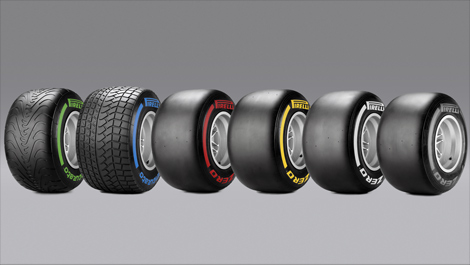 |
| 2014 F1 Pirelli tires range. (Photo: Pirelli) |
Testing Facts:
* Teams are allowed an overall maximum total of 135 sets of tires for testing this year, including the in-season tests. The maximum total for the three pre-season tests is 85 sets of tires: 25 sets for Jerez and 30 each for the two Bahrain tests.
* All four slick P Zero compounds plus the Cinturato intermediate and full wet will be available for pre-season testing. Pirelli is also bringing a special one-off ‘winter' compound to Jerez, in order to minimise the effect of potentially low ambient temperatures on track time. This is a hard compound that has been optimised to work well even in low temperatures, reducing the risk of graining (which is a common characteristic of cold weather running).
* Teams will have a certain number of fixed compound choices totalling 18 sets per car, listed on the table below, which are best suited to the Jerez circuit. Included in that total are three sets of intermediates and three sets of wets. On top of that each team was also able to choose in advance seven more sets to try in Jerez, up to the maximum of 25 sets per car in total. The ‘base' slick compounds - ‘winter', hard and medium - have been selected by Pirelli in collaboration with the teams to reflect the characteristics of Jerez.
* The 2014 regulations state that one of the 12 pre-season test days will be dedicated to wet-weather tire testing, with Pirelli arranging for the track to be watered. This is scheduled to take place on the final day of the Jerez test (January 31).
What's new for the 2014 tires:
* Pirelli has developed its new 2014 tire range using simulation technology and data supplied by teams, as well as real on-track testing results. On top of new compounds and new constructions, each rear tire now weighs 250 grams more and each front tire 200 grams more than last year.
* The front tires have a new profile, while the rear profile remains largely unaltered.
* The new compounds are generally slightly harder than their 2013 equivalents to optimise grip.
* The full wet tire has a new rear tread pattern in order to reduce aquaplaning by increasing how much water can be dispersed at full speed - now up to 65 litres per second from 60 litres per second previously. It also has a new compound that is able to work well in damp and/or drying conditions, in order to increase the crossover point to the intermediate tire.