 The latest auto news, reviews, prices, product and vehicle releases.
 Mar
24th
Stay connected Subscribe to our RSS feed
Many people will read and feel a huge controversy over tire problems in Sunday's NASCAR race at Auto Club Speedway in California. And they'd be wrong.
What they don't realize is the inconvenient truth that NASCAR officials changed downforce and camber rules that allowed teams to go aggressive on car setups and tire pressures.
As Kurt Busch eloquently explained, "Here's what we have. We have faster cars, more downforce, and NASCAR is allowing us to put whatever cambers we want into the cars, and therefore it's up to the team's discretion if you're going to have a problem or not.
"I've been in this game 15 years, and normally NASCAR mandates what certain air pressures you have to run and what cambers you have to run not to have a black eye for Goodyear, by no means is this a problem for Goodyear, it's actually a thumbs up for NASCAR allowing the teams to get aggressive in all areas."
Low pressure in the tires meant cars would go faster, but for how long? Some reports as low as 14 lbs. of air pressure where Goodyear recommended minimums of 22 lbs. for the left front 20 lbs. for left rear.
Some teams struggled with tire pressures on Friday and Saturday. That was like the canary in the coal mine warning teams about their tires. But, due to the other pressure, pressure to win races many teams persisted with a risky gamble.
Thus when a driver had a tire go down it was too easy to blame Goodyear. There may have been a dozen tire-related issues. But the folks who did did it despite the inconvenient truth that not only Goodyear but also even Kyle Busch's Toyota Racing Development recommended a certain, more conservative tire pressure. No surprise the winner didn't have tire related problems in the race.
The changes in the rules this year have made crew chiefs even more responsible than ever. Did Kyle Busch's crew chief like that?
"Yeah, I mean, absolutely," Dave Rogers, said. "You know, this racetrack is great because it has a lot of character. It's worn out. The drivers are starting at the bottom and then they move up top. The car does different things. There's bumps you've got to negotiate. There's a lot of character, so you have to have a driver that can move around. You've got to have a car that can move around. It's a lot of fun racing out here."
Speaking about low pressure Rogers was amused. "You put 12 pounds in left sides and you're going 200 milesanhour in California, you might have a leftside tire problem. That's awful low. That's dangerous."
"It looked like it was fast for a while, though," he said then turned to Busch in the media center adding "I wouldn't do that to you."
Busch smiled and said, "I appreciate it."
And that is the truth.
What they don't realize is the inconvenient truth that NASCAR officials changed downforce and camber rules that allowed teams to go aggressive on car setups and tire pressures.
As Kurt Busch eloquently explained, "Here's what we have. We have faster cars, more downforce, and NASCAR is allowing us to put whatever cambers we want into the cars, and therefore it's up to the team's discretion if you're going to have a problem or not.
"I've been in this game 15 years, and normally NASCAR mandates what certain air pressures you have to run and what cambers you have to run not to have a black eye for Goodyear, by no means is this a problem for Goodyear, it's actually a thumbs up for NASCAR allowing the teams to get aggressive in all areas."
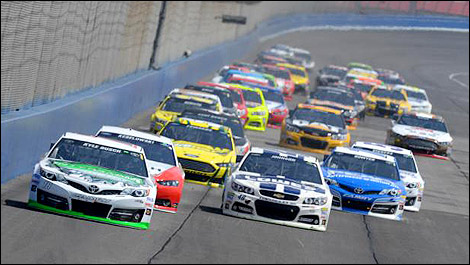 |
| NASCAR Sprint Cup start at the Auto Club Speedway. (Photo: NASCAR) |
Low pressure in the tires meant cars would go faster, but for how long? Some reports as low as 14 lbs. of air pressure where Goodyear recommended minimums of 22 lbs. for the left front 20 lbs. for left rear.
Some teams struggled with tire pressures on Friday and Saturday. That was like the canary in the coal mine warning teams about their tires. But, due to the other pressure, pressure to win races many teams persisted with a risky gamble.
Thus when a driver had a tire go down it was too easy to blame Goodyear. There may have been a dozen tire-related issues. But the folks who did did it despite the inconvenient truth that not only Goodyear but also even Kyle Busch's Toyota Racing Development recommended a certain, more conservative tire pressure. No surprise the winner didn't have tire related problems in the race.
The changes in the rules this year have made crew chiefs even more responsible than ever. Did Kyle Busch's crew chief like that?
"Yeah, I mean, absolutely," Dave Rogers, said. "You know, this racetrack is great because it has a lot of character. It's worn out. The drivers are starting at the bottom and then they move up top. The car does different things. There's bumps you've got to negotiate. There's a lot of character, so you have to have a driver that can move around. You've got to have a car that can move around. It's a lot of fun racing out here."
Speaking about low pressure Rogers was amused. "You put 12 pounds in left sides and you're going 200 milesanhour in California, you might have a leftside tire problem. That's awful low. That's dangerous."
"It looked like it was fast for a while, though," he said then turned to Busch in the media center adding "I wouldn't do that to you."
Busch smiled and said, "I appreciate it."
And that is the truth.