Volkswagen has extended a joint venture with China's FAW Group by 25 years to enhance research and development activities as it targets an increasing share of the world's biggest car market.
The Agnelli family has tightened its grip on Fiat by securing higher voting rights after the carmaker's merger into Fiat Chrysler Automobiles. The move by the Agnellis' holding company, Exor, could make Fiat Chrysler less of a takeover target.
BMW Group's core brand outsold rivals Audi and Mercedes-Benz in September thanks to strong demand in Europe, but the gap between the three luxury car brands has narrowed this year in a fierce sales race.
BMW brand outsold rivals Audi and Mercedes in September thanks to strong demand in Europe, but BMW's lead over No. 2 Audi of 20,842 vehicles has been cut by almost 8,000 in the first nine months compared with the year before.
The current Continental GT has been on the market since early 2011 but Bentley continues to expand and update the range. A great excuse for just-auto to try the latest V8 S coupe.
Nissan says its goal of becoming the top-selling Asian brand in Europe is being held back by Germany and its preference for domestic brands. To help boost sales, Nissan aims to improve its brand image and retail network in the market.
PSA/Peugeot-Citroen launched sales of its China-built DS crossover, the DS6, late last month. The crossover is the second model built exclusively for the China market after the DS5 LS.
Renault's new Twingo is radically different than the two previous generations of the minicar with a rear-mounted engine, rear-wheel drive and five doors. These features could help it pass the Fiat 500 to lead Europe's hotly contested minicar segment.
Tesla Motors will offer an all-wheel-drive system in its all-electric Model S sedan, CEO Elon Musk revealed today, giving a glimpse of the first-of-its-kind powertrain that will power Tesla's Model X crossover when it goes on sale next year.
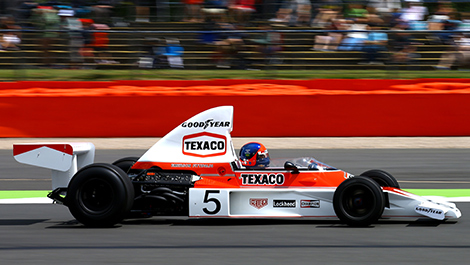
The iconic McLaren M23-Ford Cosworth was never the most technically advanced Formula 1 car entered, but sound preparation, attention to detail and talented drivers gave it 21 victories and two world titles.
1 Gordon Coppock designed the McLaren M23 for the 1973 season. Denny Hulme captured pole position at its very first race in South Africa.
Emerson Fittipaldi, driving the original M23 fitted with the giant size airbox. (Photo: WRi2)
2 Several Formula 1 rookies such as Gilles Villeneuve, Nelson Piquet and Bruno Giacomelli raced the McLaren M23.
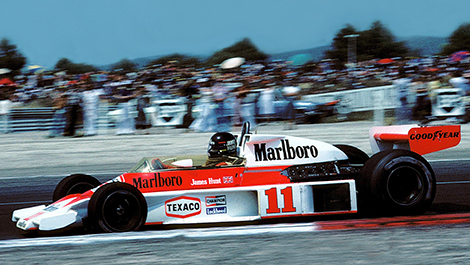
3 The McLaren M23 took two drivers to the F1 World Championship: Emerson Fittipaldi in 1974, and James Hunt in 1976.
James Hunt, behind the wheel of the modified M23 with the two small lateral air boxes. (Photo: WRi2)
4 McLaren built a grand total of 13 chassis of the M23 model.
5 Privateers purchased and modified some M23s. They received big block V8 engines to race in the F5000 series, and one was even bodied to compete in the Cam-Am Challenge in America.
6 Jody Scheckter was behind the wheel of a McLaren M23 when he triggered one the biggest pile-ups in Formula 1 history, caused by a spin at the end of the first lap of the 1973 British Grand Prix at Silverstone.
7 The M23 became the first Cosworth-powered F1 car to be fitted with a in-house modified 6-speed Hewland gearbox (instead of 5).
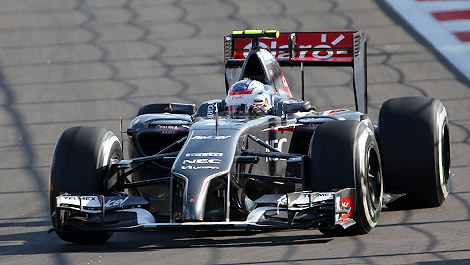
Alongside regular driver Adrian Sutil, Sauber Formula 1 test driver Sergey Sirotkin took part for the first time in the morning practice session during a Grand Prix weekend at the Sochi Autodrom.
The 18-year-old Russian drove Esteban Gutiérrez's Ferrari-powered C33 this morning.
“In one of the cars we had Sergey, who did a good job, did not make any mistakes and built up the speed progressively,” declared Giampaolo Dall'Ara, Head of Track Engineering at Sauber.
Sergey Sirotkin, Sauber, Sochi. (Photo: WRi2)
The young Russian set the 17th fastest time this morning, completing 22 laps of the new circuit.
“It was a positive session. I like the track, and it was nice driving the C33,” said Sirotkin after his stint in the car.
“I took it easy at the beginning in order to build up confidence, as I have not driven the car for about half a year, but today I was able to quickly get the feeling for it. During my last fast lap at the end of the session, I was a bit unlucky with the traffic, and the tires did not have the optimal temperature. The conditions were not ideal, which cost me some time during my last fast lap. I see a lot of potential to improve, as I took it easy, and I was not pushing to the absolute limit,” he said.
“The track is quite nice, but also tricky. Turn 1 seems to be an easy corner, which can be taken flat out. However, I was a bit surprised on my first lap when I went through Turn 1, as it was quite bumpy in one place. Nevertheless, after a few laps you get used to the track's characteristics,” Sergey Sirotkin explained.
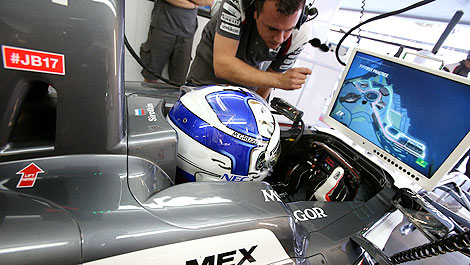
Sergey Sirotkin with Sauber's engineer. (Photo: WRi2)
Briton Graeme Lowdon, sporting director of Marussia Formula 1 Team, spoke to the reporters in the paddock osf the Sochi Autodrom.
Lowdon said the entire Marussia team was deeply moved by the incredible support his team has received in the paddock in recent days in the wake of Jules Bianchi's terrible accident at the Japanese Grand Prix last Sunday.
“It's been an incredibly difficult week for Formula 1, but it's been an incredibly difficult week for our team,” Lowdon declared in Russia.
“As you know, our driver Jules Bianchi had a terrible accident in Suzuka. He's in hospital there. He's in a critical condition and the thoughts of everybody in the team, and I know much wider than that, are with Jules at this moment and also with his family,” he continued.
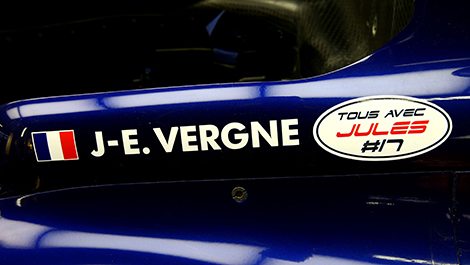
Jean-Eric Vergne had decals made to support his friend. (Photo: WRI2)
“I'd like to personally thanks Marco Mattiacci for his support and kindness, not just in his role at Ferrari, but personally as well. He was at the hospital immediately afterwards and I know provided an awful lot of comfort to those that were there.
“The Ferrari team also arranged for Professor Alessandro Frati to be present and I know that gave an awful lot of comfort to us, to the people that were there at the hospital and the family.
“Also at the hospital was Professor Gérard Saillant from the FIA and I think we have to thank Jean Todt for arranging that. I think that was extremely helpful as well and certainly provided support to us' Lowdon continued.
“None of us are medical people - we can't help in that area - but we can provide another form of support, which we hope helps at a really difficult time. From a team point of view we want to thank everyone who has provided support, especially the fans,” Lowdon ended.
During a press conference held Friday in Sochi, the FIA announced that following Jules Bianchi's nasty crash under the yellows at Suzuka, it plans to introduce a speed limit in the sections where yellows are waved.
Talking to reporters, FIA president Jean Todt explained that one of the key lessons to come out of this accident is that the speed of cars in caution zones needs to be better controlled.
The FIA introduced “Slow Zones” at the 2014 24 Hours of Le Mans to allow marshals to recover cars from the track without the need for a Safety Car whilst providing greater safety than yellow flags.
Yellow flag situation (Photo: WRI2)
Rather than neutralising the entire 13.5km of the Le Mans circuit, drivers were required to drive at 60km/h or less between two marshals' posts surrounding the area in which the incident occurred (a procedure called ‘Code 60')
Formula 1 race director, Charlie Whiting thinks that F1 needs to find a similar system where the speed of cars when double yellows are out is controlled by the FIA, rather than relying on drivers to do what they think is best.
Whiting has called team managers to a meeting in Sochi to discuss ways of introducing this for 2015.
Later during the press conference, Whiting said that the FIA would be more cautious about how it deals with situations where heavy recovery vehicles are on track from now on.
“There is nothing we can do to the tractors as such. All I can say is we will use them with extreme caution,” Whiting said.
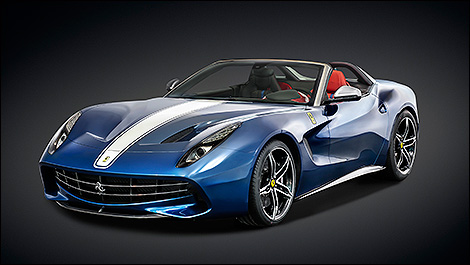
Ferrari is celebrating its 60th year in North America with the ultra-limited F60 America edition, of which just 10 will be produced. The new car is being unveiled on Saturday evening at an anniversary celebration gala dinner at Beverly Hills City Hall.
It's not the first time that Ferrari produces strictly limited edition, built-to-order cars. For example, it was the case with the 1967 275 GTS4 NART Spider, the open version of the 275 GTB4 that the importer, Luigi Chinetti, specifically requested for his U.S. clients.
The F60 America is powered by Ferrari's award-winning, mid-front-mounted V12 (output has yet to be confirmed), enabling the car to sprint from 0-100 km/h in just 3.1 seconds. By the way, the light fabric top can be closed at speeds of up to 120 km/h.
The bodywork adopts the classic North American Racing Team blue livery, with a special Ferrari 60th anniversary Prancing Horse badge on the wheel arches. Meanwhile, the cabin's asymmetrical design highlights the driver's area with sporty red trim, while the passenger side is black, inspired by the historic Ferrari competition cars.
Ferrari said that all 10 examples of the F60 America are already spoken for. Are you one of the lucky few?
Source : Ferrari
Photo: Ferrari
With the current economy the last thing you need is for your vehicle to break down. Whether your driving a reliable car or a busted up van, insurance you can rely on is a must.
 The latest auto news, reviews, prices, product and vehicle releases.