banner The latest auto news, reviews, prices, product and vehicle releases. Auto News 5

Stay connected Subscribe to our RSS feed

Do not miss the latest Auto News !

Jan
2nd

F1 Technique: Williams tested a CVT transmission back in 1993 (+video)

Stay connected Subscribe to our RSS feed
Twenty years ago, the Williams Formula 1 team tested a CVT transmission in its stunning Renault-powered FW15 Formula 1 car.

A continuously variable transmission (CVT) is a belt transmission that can change steplessly through an infinite number of effective gear ratios between maximum and minimum values. This contrasts with other mechanical transmissions that offer a fixed number of gear ratios.

It also maximizes the performance of a vehicle by allowing the engine to turn at the RPM at which it produces peak power.


The problem for using such technology in racing cars was the difficulty of finding a strong enough belt to transit the 850 horsepower from an F1 engine. Eventually, the Williams' engineers found the suitable hardware and fitted the innovative transmission to the back of a test car.

Team test driver David Coulthard drove the car on a wet July day at Pembrey in Wales.
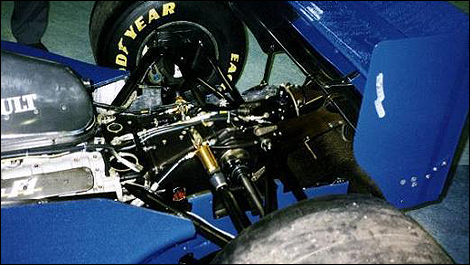
Williams CVT transmission F1
Williams' CVT transmission (Photo: Williams)

Williams' CVT FW15 car sounded revolutionary different to contemporary F1 cars because of the different way it used the engine. Instead of the revs rising and falling with each corner they remaining constant through each bend.

There was also speculation that it had instantly proved several seconds per lap quicker than the conventional Williams -- which was already miles ahead of its rivals.

That led the FIA to stipulate that, from 1994, F1 cars had to have between four and seven fixed gears -- and for good measure added a sub-clause specifically banning CVT. So the car was never actually raced and eventually found its way to the museum.
Jan
2nd

F1: Top 5 hopeless Formula 1 cars

Stay connected Subscribe to our RSS feed
In this second Top 5 feature (the first one was dedicated to the worst F1 teams), our British contributor, George East focuses on the Top 5 worst Formula 1 cars of recent years; cars that can only be described as “Ambitious but Rubbish...”.

The following, then, are a selection of cars that - on paper - were supposed to be Grand Prix winners but turned out to be huge disappointments due to bad engineering.

5
Honda RA107 - 2007
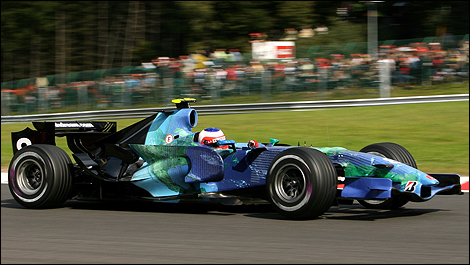
When British American Tobacco withdrew its sponsorship from the Honda F1 team at the end of the 2006 after fag sponsorship became uncool, Honda decided to replace its iconic red, white and black livery with an environmental message, so the RA107 was covered in a huge image of earth as seen from space. This would have been acceptable, but despite its current efforts, Formula 1 is still one of the least environmentally friendly sports; unsurprisingly then, Honda came in for some severe criticism from environmental types (Greenpeace) for its ‘My Earth Dreams' livery. Not only was the message seen as hypocritical, the car was also woefully slow, with the team abandoning its B-Spec car after the upgrades were seen to make no difference to its performance. Honda scored just six points in 2007 courtesy of Jenson Button, with teammate Rubens Barrichello failing to score at all.

F1 Honda RA 107 2007
Honda RA 107. (Photo: WRi2)

4
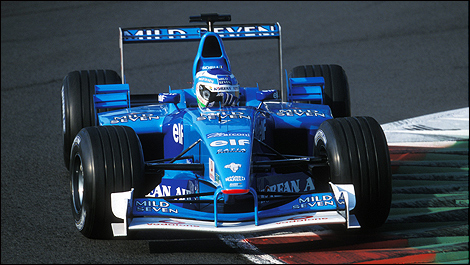
Benetton B201 - 2001
In the year that heralded Renault's return to the sport, the Renault powered Benetton B201 was, for most of the year, rubbish. In a far cry from the late ‘80s - mid ‘90s which saw the likeable Italian outfit as a regular top-three challenger, the Mike Gascoyne designed car proved to be one of the slowest cars on the 2001 grid as it struggled with poor aerodynamics and an underpowered and unreliable 111° Renault motor. For most of the year, the B201 was so bad its main competitors were the Minardis and until Hockenheim, the former championship winning team had just one point to its name thanks to Giancarlo Fisichella in Brazil. From the mid-season however, the upgrades on the car started to work and the team scored a double points finish in Hockenheim with Fisichella and Button finishing fourth and fifth. The popular Italian also scored Benetton's last podium in F1 two races later with third at Spa.

F1 Benetton B201 2001
Benetton B201. (Photo: WRi2)

3
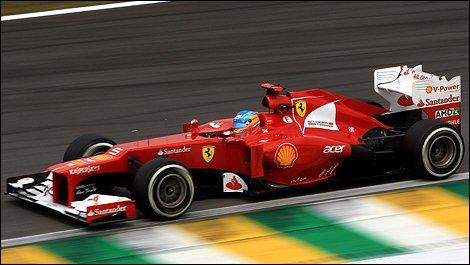
Ferrari F2012 - 2012
After a conservative 2011 which saw the Scuderia suffer a severe drubbing at the hands of Red Bull and Sebastian Vettel, Formula 1's most famous name decided to go radical with its 2012 car to try and bring the title back to Maranello. Thanks largely to Fernando Alonso, it almost did, but despite missing out on Ferrari's first title since 2007 by three points, the F2012 suffered a difficult birth. This made it difficult to drive and slow; so much so, both Alonso and Massa qualified over 1.5 seconds away from pole in Australia. However, whilst the car was far from Ferrari's best effort, Alonso managed to win the Malaysian Grand Prix in varied conditions and thanks to an upgrade at the Mugello test which turned the team's fortunes around, the F2012 became a regular point scorer in the hands of Massa, and a title contender with Alonso.

F1 Ferrari F2012
Ferrari F2012. (Photo: WRi2)

2
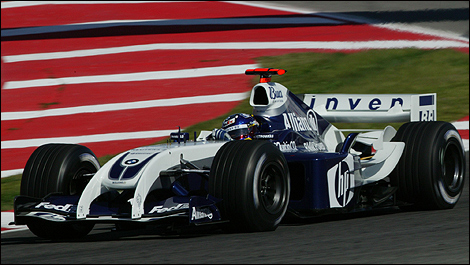
Williams FW26 - 2004
Following a 2003 season which saw Juan-Pablo Montoya push - but ultimately lose out to - Michael Schumacher close for the title, Williams decided to go radical in 2004 with its new FW26 to try finally overhaul Ferrari and Schumacher's dominance. However, it didn't and the result was a car with a short nosecone and tusks which led its ‘walrus' moniker. Not only was it an eyesore, it was difficult to set up and inconsistent, so it remained a midfield runner until the Hungarian Grand Prix when Williams bolted on a conventional nose. Happily, this proved to be a turning point for the Grove boys and girls, as Ralf Schumacher closed his season off with a second in Japan and Montoya brought the curtain down on his Williams career with a win in Brazil.

F1 Williams FW26 2004
Williams FW26. (Photo: WRi2)

1
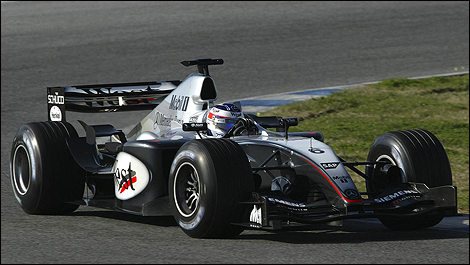
McLaren MP4-19 - 2004
Like Williams, McLaren decided to go radical with their 2004 car after losing out to on the driver's title by two points in 2003. Also, like Williams, their car proved to be somewhat of a disappointment as it was based on the MP4-18; a car so unreliable and dangerous, that it never raced. Despite the MP4-19 being a supposedly ‘de-bugged' version of its predecessor, it was by McLaren's standards, a bit of a shocker and carried over some of the reliability issues - Raikkonen retired from five of the first nine races - and a fundamental lack of pace until the French Grand Prix, when the team introduced the MP4-19B, an all-new car which won the Belgian Grand Prix in the hands of Kimi Raikkonen.

F1 McLaren MP4-19 2004
McLaren MP4-19. (Photo: WRi2)


Jan
2nd

F1: A review of technical articles about Formula 1

Stay connected Subscribe to our RSS feed
A Formula 1 car requires high levels of technology and techniques that are often derived from the aircraft and aerospace industries.

Grand Prix cars are built from exotic materials such as composites, including carbon fibre and Kevlar, and their aerodynamic performances are tested and evaluated in wind tunnels.

Let's review the articles that explain the technology involved in modern Formula 1 cars.


CHASSIS, ENGINE AND TRANSMISSION

Formula 1 cars must be powered by 2.4-litre, normally aspirated V8 engines that can rev up to 18,000rpm, and that are capable of producing some 750 horespower.

The carbon-fibre monocoque also plays the role of a survival shell in case of of an accident, protecting the driver as if he was sitting in a cocoon.

The gearbox has a maximum of 7 forward gears and reverse is mandatory. It is semi-automatic and the gear changes are activated by pulling on paddles located behind the steering wheel.

Energy Recovery Systems will change the face of F1 from 2014

Pull-rod front suspension explained

Renault reveals 2014 F1 engine

Carbon fibre monocoque explained (+video)

How an F1 team manages engines and transmissions during a season

Looking at the Renault Sport RS27 Formula 1 engine


Renault presents its 2014 electrified V6 turbo engine

A last season for the 2.4-litre, V8 Formula 1 engines

Technical differences between the V8 and the 2014 V6 turbo motors

The components of the new V6 turbo F1 power unit

Integrating the new V6 turbo hybrid engine in the 2014 cars

Starting a Ferrari V8 engine with Sauber F1 Team (+video)

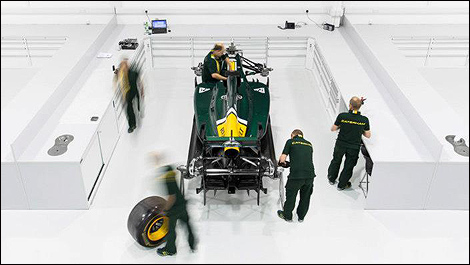
Caterham factory F1
Caterham factory (Photo: Caterham)


ELECTRONICS


Explaining engine torque maps

Pedal map - How it delivers engine power

Red Bull software deemed legal at Hockenheim

Magneti Marelli unviels new hardware for new 2014 rules

Presenting the steering wheel of Sebastian Vettel's Red Bull RB8

A lap of Albert Park's circuit in Melbourne

The steering wheels of the 2013 Formula 1 cars (+photos)

The start procedure of a Grand Prix


AERODYNAMICS

A Formula 1 car is often seen as a fighter jet that can fly on the ground. An F1 car generates enough suction, called downforce that it could -- in theory -- run on the ceiling.

The cars are fitted with flat bottoms and a rear portion, called the diffuser,  that sweeps upwards creating the suction. The front and rear wings also produce a lot of aerodynamic downforce.

What is flow visualisation paint?

Mercedes F1 W03 - 'double DRS' overview

Reviewing Ferrari's updates for Montreal

Model cars used for wind tunnel testing

Red Bull RB9's very thin rear wing in Melbourne

Mercedes AMG's 'FRIC' suspension system


What is a Coanda-style exhaust?

Ferrari's innovative DRS activation system

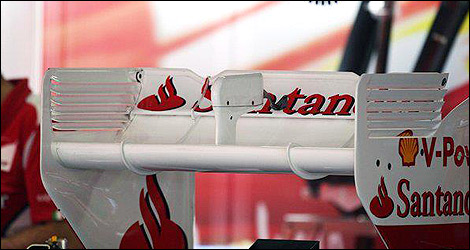
Ferrariu F1 rear wing
Rear wing (Photo: Ferrari)


CLASSIC

The '70s and '80s were a rich era of extensive technical development. Breakthroughs such as ground effects, wing cars, 6-wheel cars, turbo engines, radial tires and much more all appeared during those years of great technical freedom.

Lotus 72 -- The winningest F1 car ever raced (+photos)


A new breed of Formula 1 cars appeared in 1983 (+photos)

The day Williams ran a car without suspensions (+video)

Williams tested a CVT transmission back in 1993 (+video)


AND MORE!

Explaining the parc fermé procedure

Overview - 2013 rule changes at a glance

Explaining the activation of the Drag Reduction System (DRS)

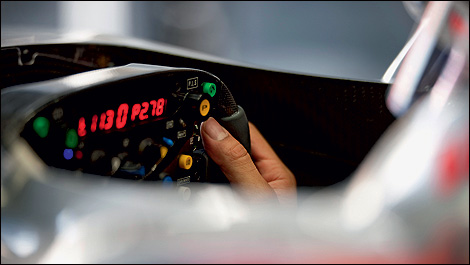
The steering wheel of the Caterham CT03 F1 car (+photos)

The steering wheel of Sebastian Vettel's Red Bull RB9

Explaining performance variance between F1 cars

How to start a Formula 1 engine (Part 1)

How to start a Formula 1 engine (Part 2)

The secrets of ballast in a Formula 1 car

Explaining the installation lap (+video)


Jan
2nd

AUTO123.COM – RSS 2014-01-02 01:00:00

Stay connected Subscribe to our RSS feed
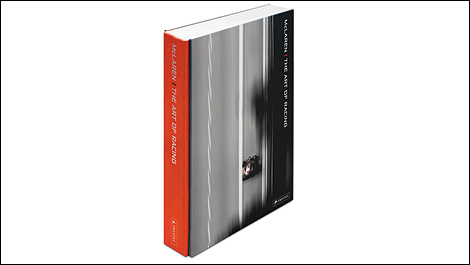
At 176 victories, 8 Constructors' titles and 12 Drivers' championships, McLaren is undoubtedly one of the most prestigious and most successful Formula 1 teams. This new book takes readers inside the organization that makes the most advanced race cars on the planet and drives the passions all-around the world.

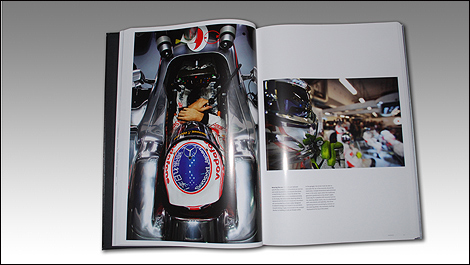
“McLaren: The Art of Racing” is a 304-page, hardcover book written by veteran British F1 journalist Maurice Hamilton featuring 280 stunning colour photos of Darren Heath, over many double-page spreads. It even features a printing technique on the cover which has never been done before in publishing.

F1 McLaren
Lewis Hamilton (Photo: Darren Heath)

The book is not only about the drivers - World Champions Lewis Hamilton and Jenson Button - but also about the people behind them: the engineers, the mechanics and the skilled workers at the factory.

This Prestel-published book takes the readers inside the $100M McLaren Technology Centre, located in Woking, U.K. - where the McLaren F1 race cars are designed, built and maintained. It also includes two very good features about Bruce McLaren and Ron Dennis - the men who shaped McLaren - and about each and every one of the team's world champions.

F1 McLaren

There is also a section detailing what goes on from the arrival of the crew members at the circuit (when they have to set up the garages), right up until the time the cars hit the track, and then how the race proceeds. The readers also learn more about what the team is up to between races; about how complex travelling from one event to the other actually is.

Another section is dedicated to the aerospace-like engineering and manufacturing processes that take place inside the McLaren Technology Centre.

F1 McLaren

This book reveals the backbone of the sport - it's everything that goes on behind the scene. People tend to forget it's not just about the race cars; it's also about the people, the technology, the passion and the know-how of the team. Even I picked up a few things from this book.

A definite must for every F1 aficionado.

To order your copy of the book, please click here.


Jan
1st

Hyundai-Kia forecast slowest sales growth in 8 years

Stay connected Subscribe to our RSS feed
Hyundai Motor and affiliate Kia Motors forecast their weakest sales growth in eight years as competition intensifies and the stronger won hampers exports.
Jan
1st

RUSSIA: Pirelli signs MoU with Rostec

Stay connected Subscribe to our RSS feed
Rostec (Russian Technologies) and Pirelli have signed a Memorandum of Understanding (MoU) concerning a joint research and development agreement in the area of materials to be used in the manufacturing of tyres.
Jan
1st

Daily automotive news and comment – from just-auto.com 2014-01-01 17:48:00

Stay connected Subscribe to our RSS feed
Connectivity plays a major part in the developments of the latest infotainment systems. Much like smartphones and other consumer devices, there is a growing expectation that in-car entertainment systems should feature internet connectivity and enable integration with mobile devices. While it has become common for consumer devices to be supplied with built-in security software or the ability to use aftermarket alternatives, few have any expectations for car security beyond alarms and immobilisers. Much like the computers first connected to the internet, current automotive architecture does not contain security measures designed to repel remote infiltration and intrusion. As such, comprehensive in-car connectivity could lead to cyber-attacks that have the potential to range from inconvenient to more serious. In this interview, Matthew Beecham spoke to Robert Boatright, director of Automotive Networking at Harman about what it is doing to counter this.
Jan
1st

Fiat agrees to buy remaining Chrysler stake in $4.35 billion deal

Stay connected Subscribe to our RSS feed
Fiat said Wednesday it had signed an agreement to buy the remaining 41.46 percent stake it does not own in Chrysler Group from the UAW's VEBA Trust, the last step needed before the Italian and U.S. carmakers can merge.
Jan
1st

Fiat agrees to buy remaining Chrysler stake in $4.35 billion deal

Stay connected Subscribe to our RSS feed
Fiat said Wednesday it had signed an agreement to buy the remaining 41.46 percent stake it does not own in Chrysler Group from the UAW's VEBA Trust, the last step needed before the Italian and U.S. carmakers can merge.
Jan
1st

10 most memorable American classics of 2013: Old American iron that passed through our camera lens last year

Stay connected Subscribe to our RSS feed
Every day this week we'll be looking back at a number of memorable classic cars as the calendar rolls over to 2014, and each day will be devoted to cars from a particular country of origin.
Jan
1st

Five memorable car adventures from 2013: Automotive endeavors, mishaps, war stories and more from the last 12 months

Stay connected Subscribe to our RSS feed
The statute of limitations has hopefully now expired, so according to my armchair lawyering -- of which I charge an exiorbant hourly fee, billable to my employers -- I'm pretty sure I can reflect upon the five most memorable drives I've done this...
Jan
1st

Seven favorite new car reviews of 2013: Coupes, trucks and Godzilla round out a great year of test drives

Stay connected Subscribe to our RSS feed
As a part of our job here at Autoweek, we review a lot of cars -- everything from the Audi A3 hatch to the Volvo XC SUV/wagon and seemingly everything in between, passed through this garage in 2013.
Jan
1st

Which of these 2013 car ads is your favorite?: Auto advertisement of the year winners will be presented at Detroit auto show

Stay connected Subscribe to our RSS feed
The 2014 One Show Automobile Advertising of the Year award finalists have been announced, covering media from broadcast TV to experiential marketing. The One Club teamed up with the
Jan
1st

AutoWeek – Car Reviews 2014-01-01 10:00:00

Stay connected Subscribe to our RSS feed
EDITOR WES RAYNAL: I've always liked Subaru vehicles. I had a yellow GL wagon in college as I've written too many times to count, but I loved that car. Put a couple hundred thousand miles on it.
Jan
1st

Automotive News Breaking News Feed 2014-01-01 09:42:44

Stay connected Subscribe to our RSS feed
Hertz Global Holdings rose to a record high after the largest publicly traded rental-car company said it adopted a so-called poison pill upon seeing 'unusual and substantial activity' in its stock.
Jan
1st

Five of our favorite German sedans of 2013: If executive transport is your thing, these five cars are sure to satisfy

Stay connected Subscribe to our RSS feed
Brutish, German luxury sedans are a sign, at least in America, that you've made it. Sure, Cadillac is making some inroads, big ones actually, but in cultural epicenters, Teutonic is still the way to go.
Jan
1st

Toyoda predicts emerging markets slowdown to persist this year

Stay connected Subscribe to our RSS feed
A slowdown in emerging markets will extend into the new year, compounding uncertainty over demand in China and at home, according to a group representing Japan's auto manufacturers.
Jan
1st

Stop/Start technology to become the norm by 2022, experts say

Stay connected Subscribe to our RSS feed
Originally developed for use in hybrid vehicles, Stop/Start technology is rapidly trickling down to every other market segment. In fact, Navigant Research is predicting that the number of vehicles equipped with Stop/Start technology around the world will jump from 8.8 million to 55.4 million by the early part of the next decade.

“The challenge for automakers is to get the biggest efficiency benefits from the smallest cost increment,” Navigant Research senior analyst David Alexander told The Detroit Bureau.

Source : thedetroitbureau.com
Jan
1st

Auto123.com Racing wishes you a Happy New Year!

Stay connected Subscribe to our RSS feed
The contributors of Auto123.com Racing are sending you their best wishes for a Happy New Year.

Wishing you a New Year
That brings luck and prosperity
Fills your home with joy and spirit
Happy New Year to all

Wishing you an exciting 2015 racing season!


Jan
1st

F1 Technique: The components of the new V6 turbo F1 power unit

Stay connected Subscribe to our RSS feed
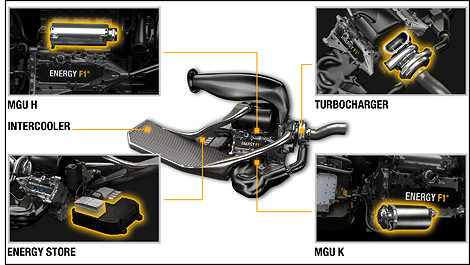
Renault Sport F1 explains here the various components of next year's V6 turbo power unit that will propel the Formula 1 cars starting next season.

Rob White, Deputy Managing Director at Renault Sport F1 explained that the next generation of F1 cars will be powered by a turbocharged 1.6-litre V6 internal combustion engine of around 600 bhp plus around 160 bhp of electrical propulsion from the energy recovery system, meaning the term ‘engine' will no longer fully describe a car's source of propulsive power. It is more relevant to refer to the complete system as a ‘Power Unit.'

F1 Renault
Photo: Renault Sport F1

TURBOCHARGER
A turbocharger uses an exhaust driven turbine to drive a compressor to increase the density of the intake air consumed by the engine and so make more power for a given displacement.

The residual heat energy contained in the exhaust gases after expansion in the cylinders of the engine is converted to mechanical shaft power by the exhaust turbine. The mechanical power from the turbine is used to drive the compressor, and also the MGU-H (see below).

As the turbocharger speed must vary to match the requirement of the engine, there may be a delay in torque response, often known as turbo-lag. One of the great challenges of the new Power Unit is to reduce this to near zero to match the instant torque delivery of the current V8 engines.

WASTEGATE
A wastegate is often used in association with a turbocharger to control the system. It is a control device that allows excess exhaust gas to by-pass the turbine, to match the power produced by the turbine to that needed by the compressor to supply the air required by the engine.

DIRECT FUEL INJECTION
With direct fuel injection (DI), fuel is sprayed directly into the combustion chamber rather than into the inlet tract upstream of the inlet valves. The fuel-air mixture is formed within the cylinder, so great precision is required in metering and directing the fuel from the injector nozzle. This is a key sub-system at the heart of the fuel efficiency and power delivery of the Power Unit.

F1 Renault V6 engine
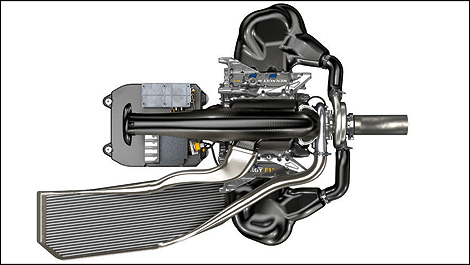
Top view of power unit. The front of the car is towards the left. (Photo: Renault Sport F1)

MGU
A motor generator unit (MGU) is an electrical machine. When operating as a motor, the MGU converts electrical energy to mechanical energy. When it operates as a generator the MGU converts mechanical energy to electrical. The 2014 Power Unit uses two MGUs; an MGU-H (H for Heat - exhaust energy recovery) and MGU-K (K for Kinetic - kinetic energy recovery during braking).

MGU-K

The MGU-K is connected to the crankshaft of the internal combustion engine and is capable of recovering or providing power (limited to 120 kW or 160 bhp by the rules). Under braking, the MGU-K operates as a generator to slow the car (reducing the heat dissipated in the brakes) and so recovers some of the kinetic energy and converts it into electricity. Under acceleration, the MGU-K is powered (from the Energy Store and/or from the MGU-H) and acts as a motor to propel the car.

MGU-H
The MGU-H is connected to the turbocharger. Acting as a generator, it absorbs power from the turbine shaft to recover heat energy from the exhaust gases. The electrical energy can be either directed to the MGU-K or to the battery for storage for later use. The MGU-H is also used to control the speed of the turbocharger to match the air requirement of the engine (e.g. to slow it down in place of a wastegate or to accelerate it to compensate for turbo-lag.)

ERS
The Power Unit's ERS (Energy Recovery System) uses the MGU-H and MGU-K plus an Energy Store, plus some power and control electronics. Heat and Kinetic Energy recovered can be consumed immediately if required by the other MGU, or used to charge the Energy Store. The stored energy can be used to propel the car by the MGU-K or to accelerate the turbocharger by the MGU-H. Compared to 2013 KERS, the ERS of the 2014 Power Unit will have twice the power (120 kW vs 60 kW) and a performance effect 10 times greater.


With the current economy the last thing you need is for your vehicle to break down. Whether your driving a reliable car or a busted up van, insurance you can rely on is a must.
Hosted by CifTech Hosting.